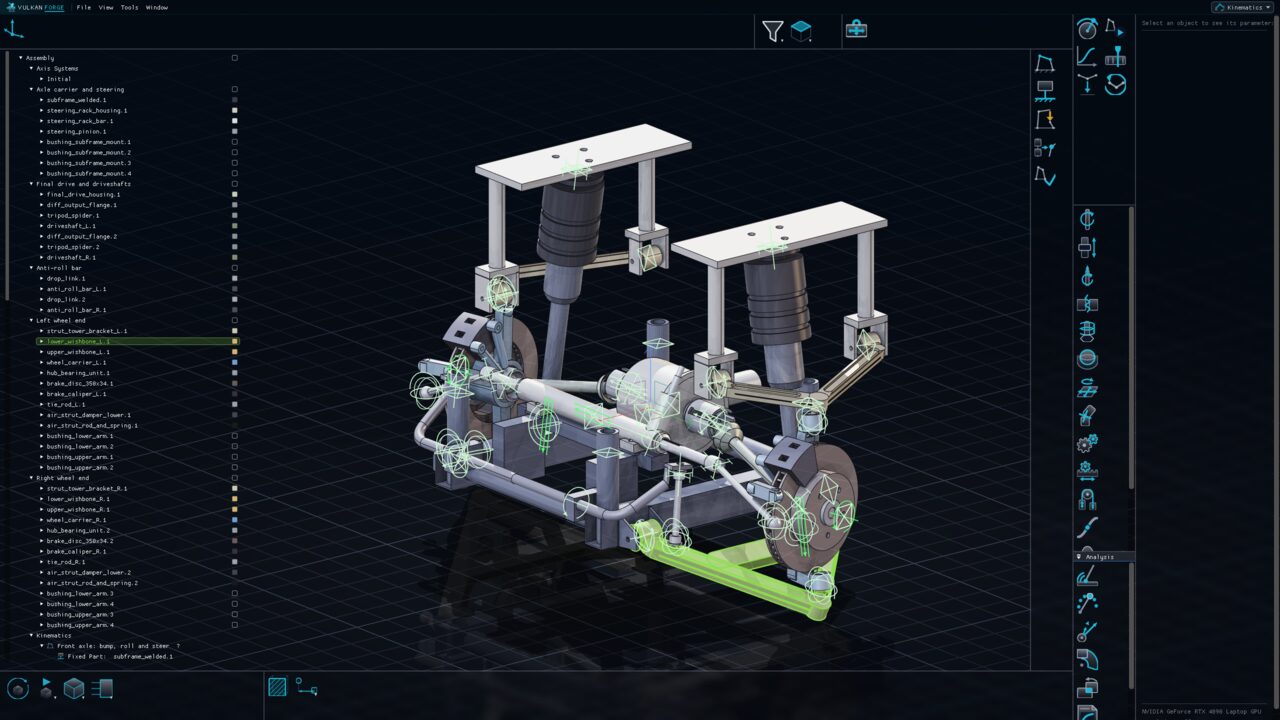
A complete double-wishbone front axle with steering and driveline, measured over its whole travel and steering range — then rebuilt with bushing stiffnesses and tyre loads for a full kinematics-and-compliance study.
Final-drive housing, tripod joints and plunging driveshafts
Brakes
Ventilated discs with 48 cooling vanes, and calipers
Kinematics & compliance
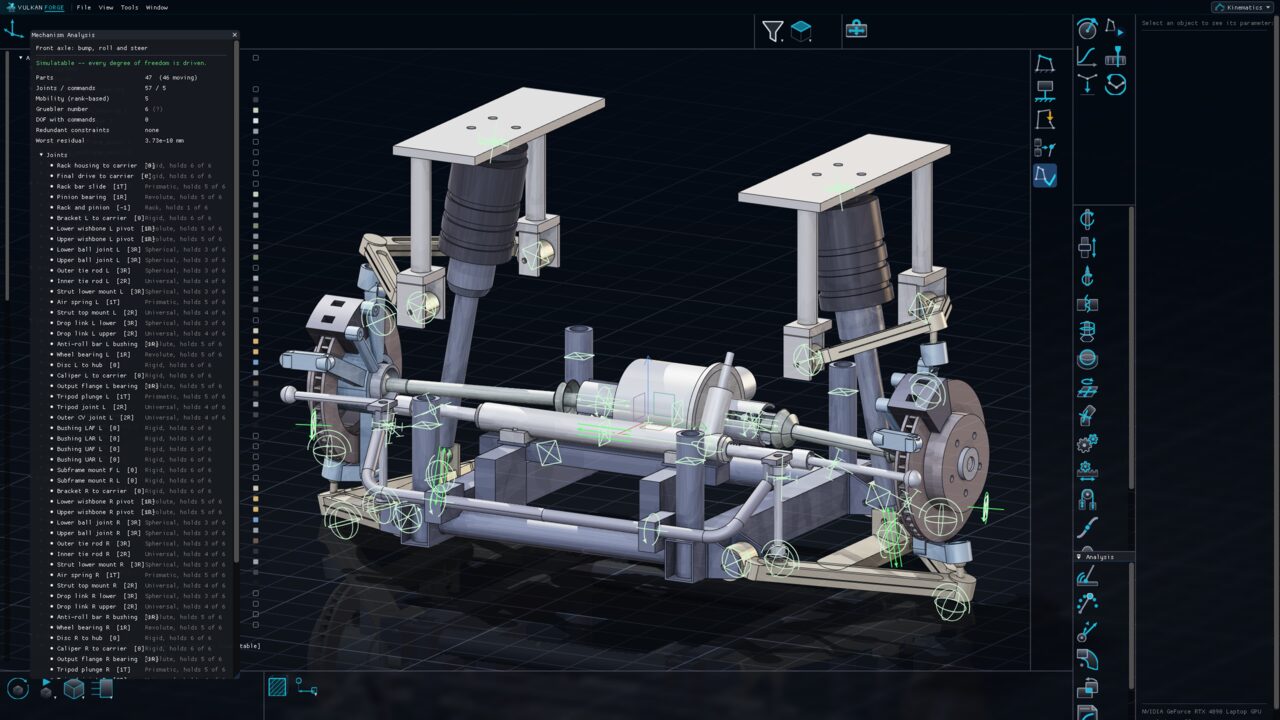
A 5-degree-of-freedom mechanism: bump, roll and steer replays with sensors and traces
An elastokinematic twin: 19 compliant joints with 85 stiffnesses, air springs and tyre loads
Kinematics-and-compliance tables exported as CSV
How it was made
The techniques that stand out
Built by an LLM over VulkanForge’s MCP server in a single day, then extended into the elastokinematic model the next day.
The right joints, first time
Where a two-ball link would spin freely a universal joint is used; the rack is driven through a pinion coupling at 48 mm per turn. The first solve gave mobility 5 with nothing to heal.
Kinematics · Universal, Rack Joint
Alignment curves, measured
Camber reaches −2.87° at 104 mm of jounce; bump steer was tuned over seven steering layouts down to 0.0007°/mm, with 31 % Ackermann.
Kinematics · Command sweeps, Sensors
Clash-checked at every pose
A 26-pose steer × travel grid took 17 rounds of fixes to go from 71 interfering pairs to zero.
Kinematics · Clash
Elastokinematics
Bushings with sourced stiffnesses, air springs at 139.8 N/mm and tyre loads solved to quasi-static equilibrium: 7 of 8 compliance values land inside published ranges.
The stiff model matches the rigid axle to 2e-5°, the compliance matrix is symmetric to 2.6e-13, and the anti-roll bar returns exactly the 78.7 N·m/deg it was designed for.
Kinematics · Compliance
Reviewed like a real design
A suspension engineer’s ten review points went back into the model — coaxial driveshafts, a longer strut, bonded bushings and cast webs.
Part Design · Assembly
Mechanism analysis of the front axle
Simplified on purpose
Ball joints, CV joints and wheel bearings are rigid; dampers are not modelled.
Bushing stiffnesses are chosen from sourced ranges and tuned to published bands, not measured on a part.
 Part Design
 Assembly
 Kinematics