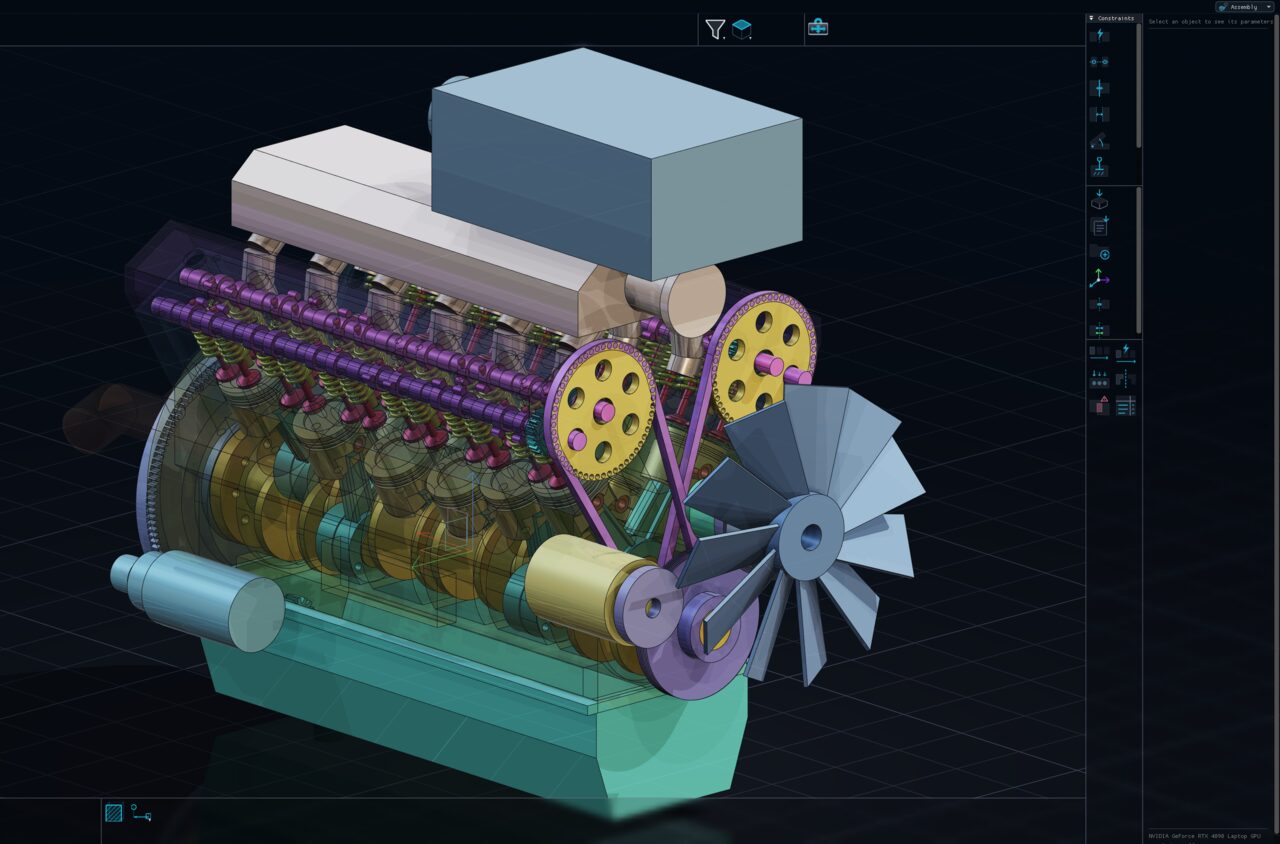
Built entirely by an LLM over VulkanForge’s MCP server — no UI involved — then assembled and driven as a mechanism.
The engine is a generator
Bore, stroke, rod length and bank angle live in one parameter module. Changing the valve timing to follow the firing order was a single edit to one phase function.
Parameters and formulas
Exact before it moves
All twelve slider-crank loops closed to 2.8e-14 mm before a single joint was added; the first mechanism analysis returned a residual of 1.0e-12.
Kinematics · Mechanism Analysis
A cam lobe with a known law
The lobe is shaped so the flat-follower lift is exactly max(0, 20·cos θ − 11). Measured valve motion matches that law to 1.1e-4 mm over 9 mm of lift.
Sketcher · Part Design
Many shapes, one feature
The 130-tooth starter ring gear is one sketch and one cut; every intake runner and exhaust pipe comes from one reusable “tube between two points” routine.
Part Design · Pocket, Rib
Self-checking construction
Every step’s volume is predicted and compared. Twelve bores that removed 0.95 M mm³ instead of 5.1 M were caught at once, although every call had reported success.
Measure · MCP feature deltas
Timing, verified
Top-dead-centre events land 60° apart, every piston travels exactly 75.000 mm, and valve-to-piston clearance at overlap is 0.756 mm.
Kinematics · Sensors
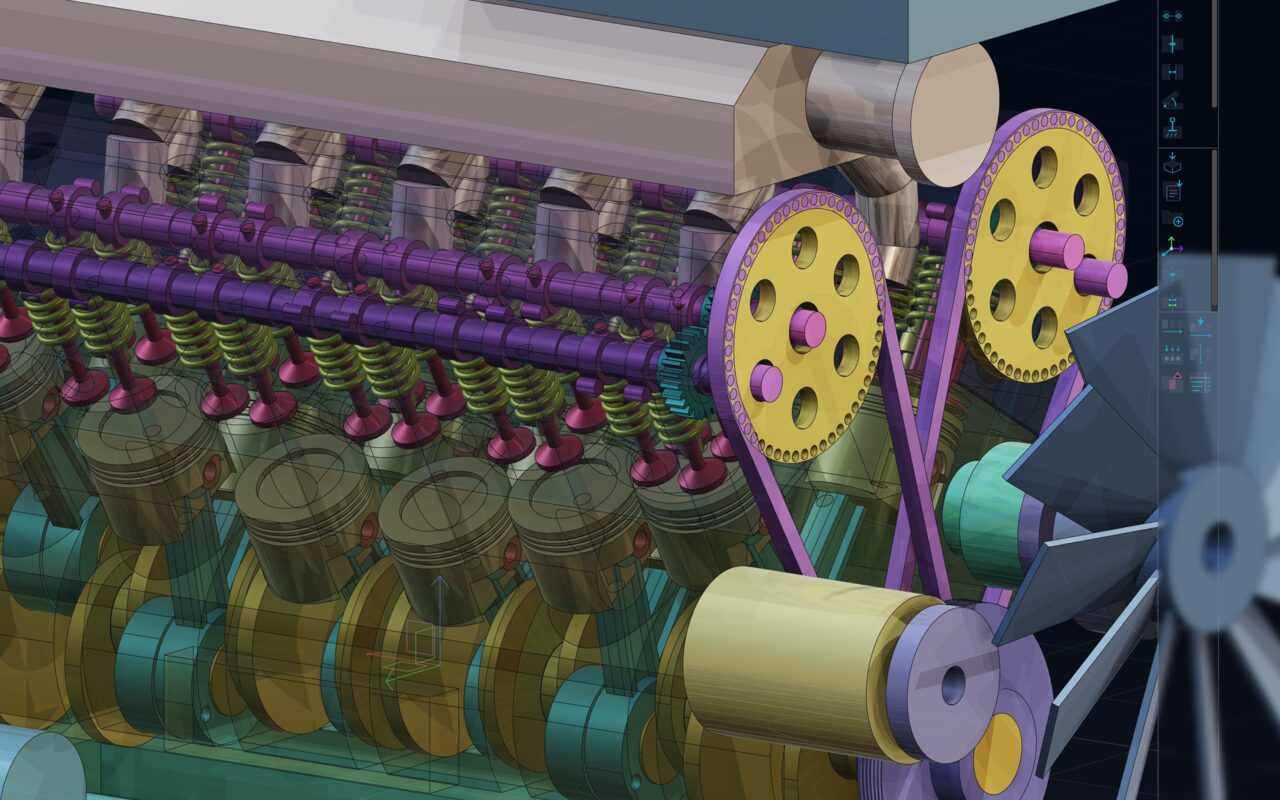
V12 valvetrain close-up
Simplified on purpose
The valvetrain follows the crank through parameter formulas rather than joints; only the crank train is a single-degree-of-freedom mechanism.
 Part Design
 Assembly
 Kinematics